
Microsurgery Robot Market revenue to cross USD 2.1 Bn by 2026: Global Market Insights, Inc.
Dec 14, 2020
SELBYVILLE, Del. - December 14, 2020 - (Newswire.com)
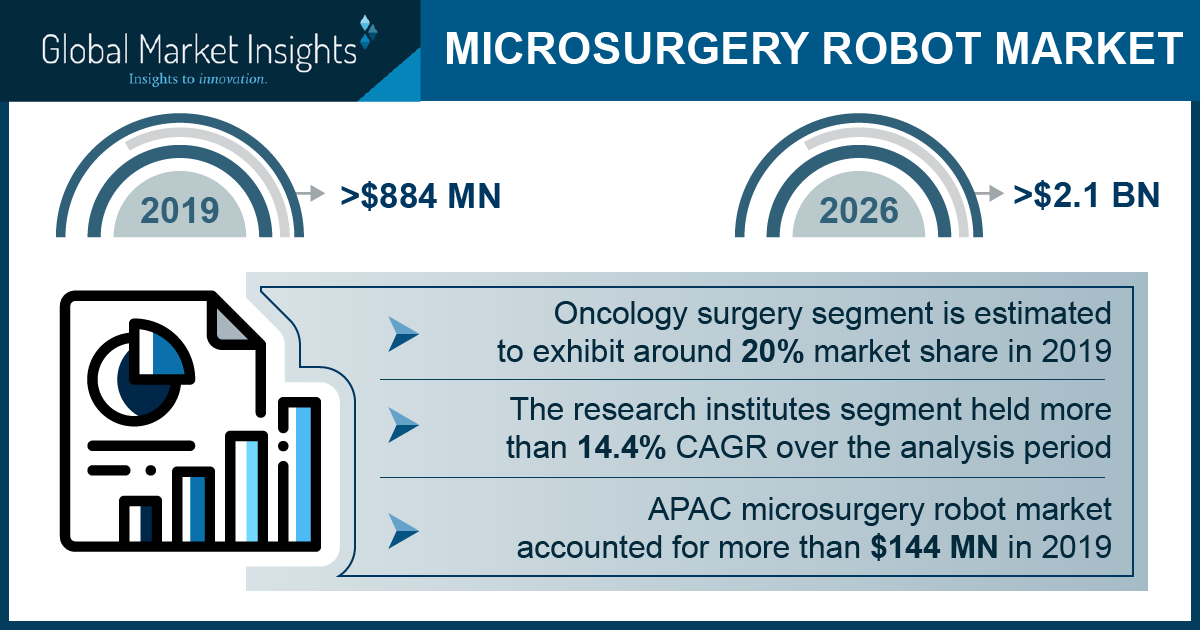
According to the latest report "Microsurgery Robot Market by Application (Ophthalmology Surgery, Cardiovascular Surgery, Neurovascular Surgery, Gastrointestinal Surgery, Obstetrics and Gynecology Surgery, Urology Surgery, Oncology Surgery, ENT Surgery, Reconstructive Surgery, Micro Anastomosis, Ureterorenoscopy), End-use (Hospitals and Clinics, Ambulatory Surgical Centers, Research Institutes), Regional Outlook, Price Trends, Competitive Market Share & Forecast 2026", by Global Market Insights, Inc., the market valuation of microsurgery robots will cross $2.1 billion by 2026. Strategic initiatives for developing innovative microsurgery robot devices will accelerate market demand.
Increasing cases of chronic diseases will drive market expansion. Chronic disorders such as cancer, cardiovascular disease, neurological disorders, stroke, diabetes, and others will escalate the need for surgical procedures. Similarly, sedentary lifestyle changes such as smoking, and alcohol consumption will lead to increasing disease prevalence augmenting the demand for microsurgery robot devices. Microsurgery robots have enormous applicability in neurological surgeries, oncological surgeries, and cardiovascular surgeries. Usage of advanced surgical robots for surgeries in hospitals and ambulatory surgery centers will in turn surge the number of robotic-assisted surgical procedures.
Request a sample of this research report @
https://www.gminsights.com/request-sample/detail/2814
The oncology surgery segment held around 20% microsurgery robot market share in 2019. Robotic surgery can be employed for the treatment of several types of cancer such as colorectal cancer, prostate cancer, lung cancer and others. The increasing prevalence of cancer across the globe will significantly contribute toward segmental progression. According to the World Health Organization (WHO), it was estimated that around 9.6 million cancer-related deaths occurred globally in 2018.
The research institutes segment will grow at more than 14.4% CAGR during the forecast period. The growing number of research projects will increase the demand for microsurgery robots. The rising need to enhance accuracy and reduce the cost of surgical robots will lead to an increase in R&D activities, propelling the overall segment progression. The growing support of government and funding in research processes will substantially escalate segment growth.
The Asia Pacific microsurgery robot market accounted for USD 144 Mn revenue in 2019, attributed to the increasing demand and advantages offered by microsurgery robots. Robot-assisted surgical procedures offer advantages such as less pain, low chances of infection, and reduction in hospital stays. Due to the increasing demand for microsurgery robots in the Asia Pacific region, several market players are taking initiatives to make microsurgery robots available in this region.
Some of the eminent players functioning in the microsurgery robot market include Intuitive Surgical, Stryker, Zimmer Biomet, Medrobotics corporation, Corindus Inc (Siemens Healthineers), Auris Health (Johnson & Johnson), Meerecompany, Smith & Nephew, Medtronic, TransEnterix Surgical and Titan Medical. These market players are focusing on developing innovative products that help the company increase its market share globally.
Read the latest blog on "How will microsurgery robots redefine modern healthcare dynamics?":
https://www.newsorigins.com/microsurgery-robot-industry
Table of Contents (ToC) of the report:
Chapter 3 Microsurgery Robot Market Insights
3.1 Industry segmentation
3.2 Industry landscape, 2015 - 2026
3.3 Industry impact forces
3.3.1 Growth drivers
3.3.2 Industry pitfalls and challenges
3.4 Growth potential analysis
3.4.1 By application
3.4.2 By end-use
3.5 COVID-19 impact analysis
3.6 Regulatory landscape
3.7 Technology landscape
3.7.1 Robotic-assisted Laparo-endoscopic
3.7.2 Computer-integrated surgery (CIS)
3.7.2.1 Surgical CAD/CAM systems
3.7.2.2 Surgical assistants
3.7.3 Novel surgical robotic system
3.8 Porter's analysis
3.9 Competitive landscape, 2019
3.10 PESTEL analysis
Browse Complete Table of Contents (ToC) @
https://www.gminsights.com/toc/detail/microsurgery-robot-market
About Global Market Insights, Inc.
Global Market Insights, Inc., headquartered in Delaware, U.S., is a global market research and consulting service provider, offering syndicated and custom research reports along with growth consulting services. Our business intelligence and industry research reports offer clients with penetrative insights and actionable market data specially designed and presented to aid strategic decision making. These exhaustive reports are designed via a proprietary research methodology and are available for key industries such as chemicals, advanced materials, technology, renewable energy, and biotechnology.
Contact Us:
Arun Hegde
Corporate Sales, USA
Global Market Insights, Inc.
Phone: 1-302-846-7766
Toll Free: 1-888-689-0688
Email: [email protected]
Related Links
Surgical Robots Market Forecasts
Healthcare Assistive Robot Market Forecasts
Press Release Service by Newswire.com
Original Source: Microsurgery Robot Market revenue to cross USD 2.1 Bn by 2026: Global Market Insights, Inc.
More News





YOUR NEWS, OUR NETWORK.
Do you have Great News you want to tell the world?
Be it updates about your business or your community, you can make sure that it’s heard by submitting your story to our network reaching hundreds of news sites across 6 verticals.