In Wakayama, a Cup of Coffee Reveals the Distinctive Charm of Kissaten

Oct 26, 2026

From locally recommended breakfasts and puddings to interiors shaped by individual tastes, the Japan Consumer Aesthetics and Cultural Tourism Association invites travelers to discover local life through Wakayama’s café culture.
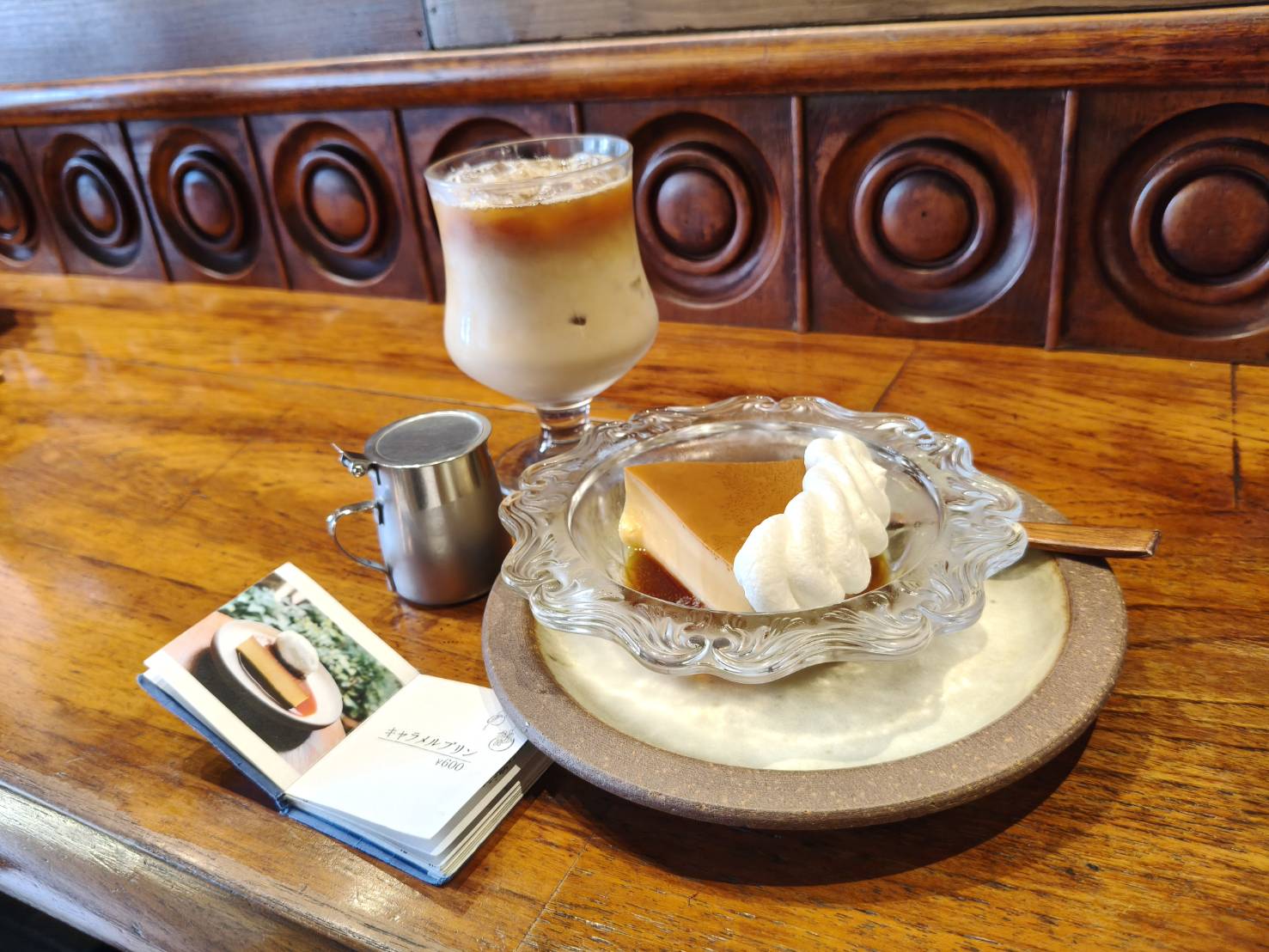
At Café Bohemian (Cafe ぼへみあん), pudding topped with whipped cream is served on an ornate glass plate at a wooden counter. The appeal of a kissaten lies not only in its flavors, but in the details brought to the table. (Photo via Japan Consumer Aesthetics and Cultural Tourism Association)

OSAKA, JAPAN (MERXWIRE) – A Taiwanese traveler who had visited Osaka many times came to Wakayama on this trip for its cafés. Having explored the city and tried its popular chain restaurants, he was drawn by the promise of cafés with distinctive personalities and their owners’ individual touches. After his meal, he said: “I’ve been to Osaka so many times that I’ve already explored the city and tried just about all the popular chain restaurants. I heard Wakayama had several interesting cafés, so I came to check them out. They really were fascinating—each one reflected the owner’s personality, with distinctive décor and food.”

His experience captures the starting point for the Japan Consumer Aesthetics and Cultural Tourism Association’s introduction to Wakayama’s individually operated kissaten, or traditional Japanese cafés: Once travelers look beyond familiar signs, can a café’s décor, menu and the choices its owner has made offer another way to understand a place? Here, the appeal lies not only in finding the best cup of coffee, but in discovering what makes each café different.

Individual Ownership: A Foundation of Local Kissaten Culture

Based on café establishment counts from the 2021 Economic Census for Business Activity and population figures from the 2020 Population Census, Wakayama Prefecture had approximately 1.033 kissaten per 1,000 residents, ranking third in Japan behind Gifu, at 1.209, and Kochi, at 1.206.

Wakayama led the country, however, in the proportion of individually operated cafés. A report published by the Statistics Bureau of Japan in 2016, drawing on the 2014 Economic Census, found that individually operated establishments accounted for 75.8% of kissaten nationwide, compared with 92.3% in Wakayama—a difference of 16.5 percentage points. In other words, roughly nine out of every 10 kissaten in Wakayama were individually operated at the time, giving this form of ownership an especially prominent place in the local industry.
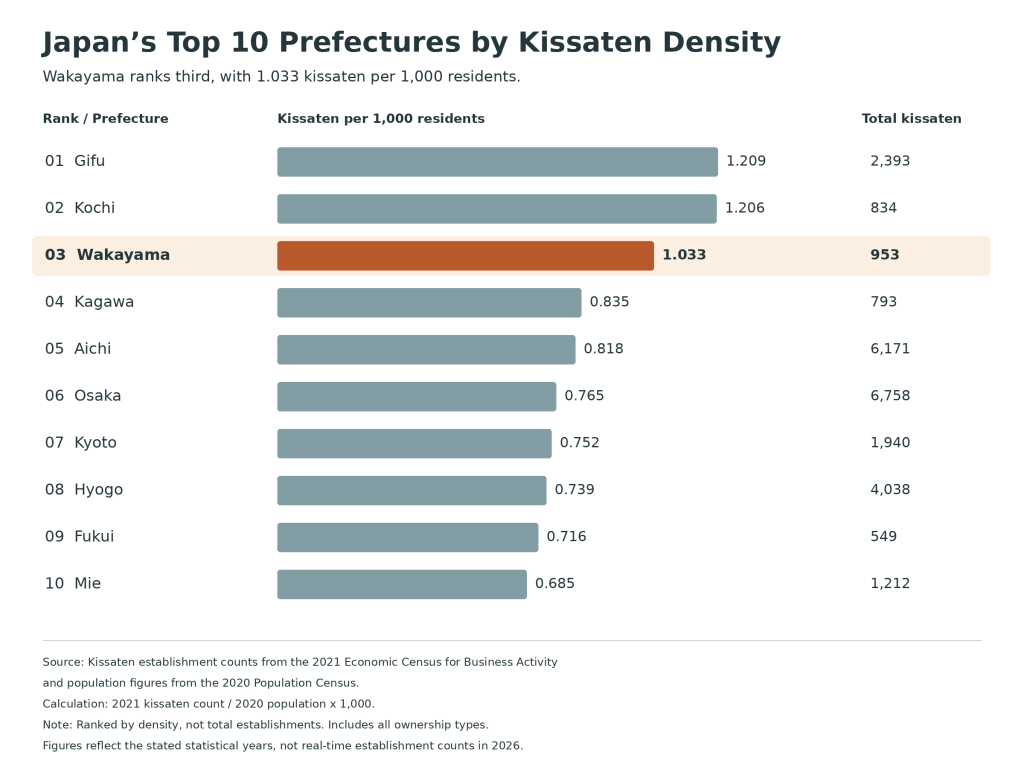
Wakayama ranks third in Japan for kissaten density. (Chart via Japan Consumer Aesthetics and Cultural Tourism Association)
RankPrefectureShare of Individually Operated Kissaten
1Wakayama92.3%
2Kochi91.9%
3Okinawa87.7%
—Japan overall75.8%
Wakayama had Japan’s highest share of individually operated kissaten. Source: 2014 Economic Census results, compiled in a report published by the Statistics Bureau of Japan in 2016. (Chart via Japan Consumer Aesthetics and Cultural Tourism Association)

The two sets of figures refer to different years and are not real-time measures. Nevertheless, they illustrate both the density of Wakayama’s kissaten and the importance of individual ownership within the industry. “Individually operated” is a statistical classification of business organization, not an exact synonym for “non-chain”: an independent café may also operate as a corporation.

For travelers, the numbers offer a starting point for curiosity and exploration. What truly distinguishes one café from another often emerges only after stepping inside: how a meal is put together, how coffee is served and what kind of space makes a visitor want to linger.

An Official Tourism Feature Brings Residents’ Everyday Favorites Into the Journey

On April 28 this year, Wakayama Prefecture’s official tourism website published a feature titled “Wakayama Residents Recommend: 20 Kissaten and Menu Favorites.” Built around recommendations from local residents, it brings together favorite establishments, dishes and reasons for returning, giving travelers more than a list of names.

The feature introduces 20 establishments through categories including pancakes, puddings, breakfast sets, parfaits, original desserts, sandwiches and meals. It defines jun-kissa as cafés primarily intended for enjoying coffee, tea and light meals, rather than judging them solely by their age or retro interiors.

Residents’ comments make those categories tangible. Some praise double-stacked pancakes cooked to order; others remember firm-textured puddings that pair well with coffee. Recommendations also include sandwiches filled with Japanese omelets flavored with dashi, and coffee prepared cup by cup using siphons or cloth filters.
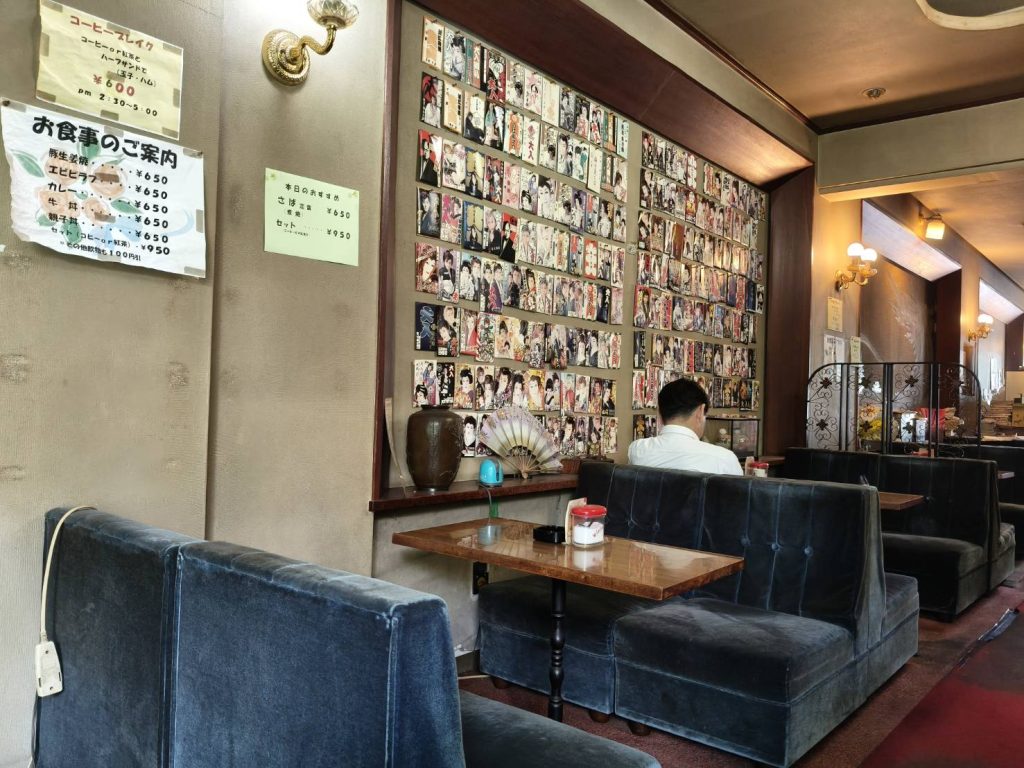
Wall-to-wall collectibles and retro seating at Coffee Shop Nakamura (コーヒーショップ ナカムラ) express the owner’s distinctive personal style. (Photo via Japan Consumer Aesthetics and Cultural Tourism Association)

Their accounts extend beyond food and flavor. Residents describe favorite seats, the ease of walking in alone and the desire to bring friends from other prefectures. For visitors, these observations offer an alternative to popularity rankings: A café may be worth visiting not because of how many people know it, but because of how it is remembered by those who know it well.

During September and October this year, Nankai Electric Railway also made its free publication, Natts, available at stations in and around Wakayama. The publication introduced several privately run establishments that had been in business for around half a century. Under the title “An Introduction to Half-Century-Old Kissaten,” it brought café culture into passengers’ journeys.

For travelers who had yet to decide on their next stop, a page picked up at a station could become an invitation to enter a long-established local café. A dessert or a cup of coffee might be the beginning of an encounter with a distinctive character cultivated over decades—and turn a place they might otherwise have passed through into somewhere worth staying.

Beyond a Period Look or a Familiar Name: Experiencing an Individual Café

After dining at a kissaten in Wakayama, an American traveler described how its wooden furniture, old-fashioned coffee cups and cream soda created an atmosphere different from the dining spaces he knew. “I love the atmosphere here. It feels a little like stepping back into the 1960s or 1970s, but with a uniquely Japanese touch. The wooden furniture, the old-fashioned coffee cups, and the cream soda all make the experience feel special.” He continued: “In the U.S., retro diners are often lively and colorful, but this café feels quieter and more intimate. It’s not just about having coffee—it’s about experiencing a different side of Japanese culture.”
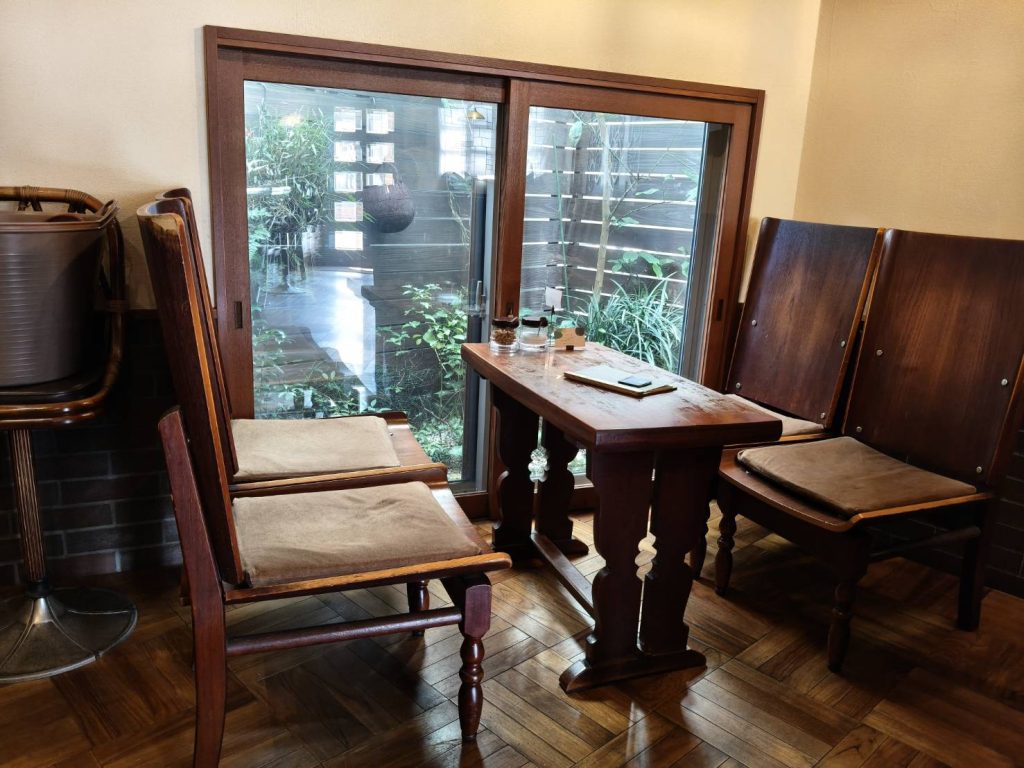
Wooden tables and chairs, soft light and greenery beyond the window define a corner of Café Bohemian (Cafe ぼへみあん). (Photo via Japan Consumer Aesthetics and Cultural Tourism Association)

For this traveler, the sense of another era was an impression, not a statement about when the café opened. What he noticed was not simply that things looked old, but that familiar objects had been brought together in a different way, creating an unfamiliar dining experience.

His observations echo those of the Taiwanese traveler. One sought something new after repeated visits to Japan; the other understood the space through comparisons with his own culture. Neither was describing a standardized experience. Each was recalling the impression an individual café had left.

Making the Owner’s Choices Part of the Journey

Through its introduction to Wakayama’s individually operated kissaten, the Japan Consumer Aesthetics and Cultural Tourism Association hopes to shift travelers’ attention from “What must I eat?” to “What makes this place distinctive?” Here, consumer aesthetics centers on the individuality of a business: how an owner chooses cups and plates, plans a menu and shapes a space—and how visitors form their own impressions from those choices.

The residents’ recommendations collected by the official tourism website allow travelers to approach familiar local routines through a breakfast, a pancake or a cup of coffee. Their visits, in turn, offer tangible support for the care local businesses put into their work. For those who have visited Japan many times, Wakayama’s kissaten offer a new journey beyond familiar itineraries. The next decision about where to stop need not be guided by the best-known sign. It may begin instead with a simple curiosity: What kind of place has this owner chosen to create?

Media Contacts:
Japan Consumer Aesthetics and Cultural Tourism Association

PR Agency:
MERXWIRE INC.
Ada Huang
[email protected]

SOURCE: Japan Consumer Aesthetics and Cultural Tourism Association

More News

Man City’s perfect start ended by Aston
Oct 25, 2026

Man City’s perfect start ended by Aston

LONDON — Manchester City's flawless start to the Premier League season was ended in a 2-1 defeat at Aston Villa on Saturday that allowed Arsenal to join them at the top of the table with victory over Everton. Tottenham won at Chelsea for just the second time in 42 visits to Stamford Bridge as Mike Penders's own goal and a Cole Palmer red card cost the Blues in a 2-0 defeat. Enzo Maresca had become the first manager to win his first seven Premier League games in charge of a new club but failed to find a solution to City's struggles at Villa Park, where they have now lost for the past four seasons. Nicolas Jackson struck twice for Unai Emery's men to continue a fine run of form for a new-look Villa side. Erling Haaland briefly levelled early in the second half, but Maresca was left to rue City not making more of their dominance for large spells of the game. "We lost because we probably are not being clinical enough in their box," said Maresca. The Villa side that won the Europa League last season was decimated by high-profile departures during the transfer window. But Emery has quickly molded his new squad into shape with Jackson proving his critics from a difficult spell at Chelsea wrong. The Senegal international pounced on an error by Marc Guehi to fire Villa ahead after just six minutes. Another of Villa's new signings Zion Suzuki then thwarted City with a string of stunning saves. Haaland headed in his 13th goal in 10 games this season to equalize. Villa, though, swiftly responded as Gianluigi Donnarumma failed to keep out Jackson's low shot on the hour mark. "A fantastic day to share with our supporters in Villa Park," said Emery. "We felt that this is our fortress and the energy the supporters gave us was really fantastic." Arsenal took advantage to move alongside City on 21 points from eight games with a routine 2-0 win against Everton. Shorn of the creative inspiration of Bukayo Saka, who is set for a lengthy spell on the sidelines with a thigh injury, Arsenal had to rely on their set-piece prowess to get the job done. Ezri Konsa bundled in his first goal for the club after Everton failed to clear a corner to open the scoring on seven minutes. AFP

UST, UP victorious in Round of 8 opener
Oct 25, 2026

UST, UP victorious in Round of 8 opener

MANILA, Philippines — University of Santo Tomas weathered a fourth-set scare from Ateneo De Manila University to eke out a 25-16, 25-20, 21-25, 25-21, victory in the Round of 8 Pool F opener of the 2026 Shakey’s Super League (SSL) Unity Cup Round of 8 on Sunday at the Imus Sports Complex. The Golden Tigresses held off the Blue Eagles in the tight fourth frame after squandering a six-point lead to remain unbeaten in the league’s centerpiece competition, backed by Shakey’s Pizza Parlor, Peri-Peri Charcoal Chicken, Potato Corner and R&B Milk Tea. UST controlled the first two sets, only to lose steam in the third before showing resolve late in the fourth to seal the two-hour, nine-minute win and inch closer to clinching a quarterfinals twice-to-beat advantage. “Sa third set, nakulangan kami sa attack variation and 'yung diskarte namin since nababasa na ng kalaban 'yung mga ginagawa namin. 'Yung ginawa naming adjustments sa fourth set is mas sinipagan namin and mas naging mahaba ang pasensya namin sa sarili namin kapag naba-block o nadedepensahan kami,” said Tigresses winger Marga Altea, who scored 15 points on 11 kills and four kill blocks. Ashlee Knop finished with 12 points while Angge Poyos and Regina Jurado added 11 markers each for UST, which extended its winning streak to four after sweeping the first round. After surrendering the third set, the Tigresses raced to an 18-12 lead in the fourth. However, Ateneo refused to go down without a fight and countered with an 8-2 run to tie it at 20. But the Blue Eagles shot themselves in the foot after Dona De Leon and Alexia Montoro committed back-to-back errors, giving UST a two-point cushion. Jihan Chuatico saved a point for Ateneo but UST scored three straight points, capped by a Poyos ace to close the match. De Leon and Bea Buena finished with 12 points each while Chuatico had nine markers for the Blue Eagles. Meanwhile, University of the Philippines recovered from an opening set hiccup to beat Letran, 21-25, 25-22, 25-22, 25-16, in Pool F. The Fighting Maroons carried the momentum of their three-game first-round sweep to draw closer to clinching a quarters incentive in the competition, which has the Philippine Sports Commission, the Commission on Higher Education, Mikasa, Asics, Rigour Technology, Jersey Haven, Solar Sports and 12 Beyond Production as technical partners. Jelai Gajero pumped in 17 points on 15 kills and two kill blocks to lead UP. Jenn Gould had 14 markers on 12 attacks and two kill blocks while Kianne Olango scored 12 of her 13 points on spikes for the Fighting Maroons, who got 32 free points off the Lady Knights’ errors. Setter Kizzie Madriaga tallied 15 excellent sets while backup playmaker Julia De Leon dished out 14. UP regrouped after surrendering the first set as it showed composure and grit in the tight closing stretches of the second and third frames. The Fighting Maroons used a 6-0 spurt to break a 12-12 tie and gain control of the fourth frame. UP opened an eight-point lead, 22-14, before finishing off the Lady Knights with a 3-2 run capped by an Olango offspeed hit. “Need lang talaga namin and makabawi doon sa first set kasi nga medyo off ang laro namin nung first set. Sinabi rin ni coach na gamitin ang utak kaya yun tinrabaho lang talaga naming lahat,” Gould said. “We worked as a team kaya nanalo kami,” she added. Judiel Nitura was the lone Letran player in double-digit scoring after logging 12 points on 11 kills and an ace. Gia Maquilang and Kaizah Huyno added nine markers each for the reigning NCAA champion. Action continues on Wednesday at the Ninoy Aquino Stadium. All games in the competition are available live and on demand via PusoP.com and Solar Sports.

Russia to host 2030 world weightlifting champs in Olympic federation first
Oct 25, 2026

Russia to host 2030 world weightlifting champs in Olympic federation first

PARIS, France — Moscow was announced Sunday as host of the 2030 world weightlifting championships, the sport's governing body becoming the first Olympic federation to hand Russia global staging rights since 2022. No world championships in an Olympic sport, summer or winter, have been held in Russia since the start of the war against Ukraine. The 2025 world swimming champs, initially attributed to the Russian city of Kazan, were moved to Singapore. "Concerning the IWF (Senior) World Championships in 2029, it will be staged in Ahmedabad (India), and Moscow (Russia) will host the 2030 edition," the International Weightlifting Federation (IWF) said in a statement. IWF general secretary Jose Quinones added that "all the bids we received were excellent and we are sure that the championships in your respective countries will be a huge success". In a post on Telegram, Russian Weightlifting Federation president Aleksandr Vinokurov thanked the IWF "for their trust", with the 2030 world champs also serving as a qualifying event for the 2032 Olympic Games. "Russia has all the necessary experience and capabilities to host competitions of the highest level," he said. "Moscow has repeatedly staged major international sporting events and has modern infrastructure." The federation toasted its success in snagging the hosting rights. "The Russian Weightlifting Federation is the first Olympic sports federation to succeed in bringing a top-level official competition back to the country in many years," it said. The decision to name Moscow as the host is a ground-breaking one and comes in the wake of the International Olympic Committee (IOC) announcing a pathway for Russian athletes to compete in international competition. A state-sponsored doping program implemented, according to the World Anti-Doping Agency, at the 2014 Sochi Winter Olympic Games, and the assault on Ukraine launched by President Vladimir Putin in 2022 resulted in Russians competing in various guises at international competition, most recently as Individual Neutral Athletes. However, on July 7 Russia came in from the cold when the IOC eased restrictions on Russian athletes and opened a pathway for them to compete in qualifying events for the 2028 Los Angeles Olympics. A furious Ukraine filed an appeal to the Court of Arbitration for Sport (CAS) requesting that the IOC decision be annulled.

YOUR NEWS, OUR NETWORK.

Do you have Great News you want to tell the world?

Be it updates about your business or your community, you can make sure that it’s heard by submitting your story to our network reaching hundreds of news sites across 6 verticals.