
Commercial Mini PC Selection: Performance and Total Cost of Ownership (TCO) Comparison
Oct 15, 2026
Hong Kong, Hong Kong S.A.R. Oct 14, 2026 (Issuewire.com) - Modern workplace computing demands a rigorous reassessment of hardware procurement economics. For small-to-medium enterprises (SMEs), home-based professionals, and corporate IT departments, desktop hardware decisions frequently stumble into one of two costly extremes: either overinvesting in monolithic desktop towers whose compute headroom remains largely idle, or purchasing substandard entry-level hardware that rapidly degrades into workflow bottlenecks, thermal throttling, and premature hardware failure. Navigating this procurement landscape requires evaluating systems through a best value budget mini PC lineup framework that balances sustained silicon throughput, thermal design power (TDP), physical footprint, and long-term total cost of ownership (TCO).
A comprehensive hardware evaluation examines how processor microarchitectures, system memory bandwidth, solid-state storage bus standards, and chassis thermal engineering align with discrete operational tiers. Rather than relying on generic performance assumptions, assessing specialized commercial endpoints from BMAX alongside industry benchmark standards provides clear, quantifiable metrics. This performance and price comparison deconstructs commercial mini PC tiers, benchmark efficiencies, modular upgrade pathways, and enterprise-grade warranty safeguards to guide optimal hardware deployment.
Deconstructing Computing Value: Workload Mapping and Return on Hardware Investment
True commercial value in business computing extends substantially beyond the initial capital acquisition cost shown on an invoice. An effective procurement strategy calculates the real return on investment (ROI) by analyzing processing responsiveness per watt, memory bus saturation limits, storage input/output operations per second (IOPS), and expected trouble-free lifespan across a three-to-five-year deployment cycle. Deploying an oversized 300W-500W traditional desktop tower for web-based ERP input or retail point-of-sale (POS) stations incurs continuous electrical waste and consumes valuable physical desk space. Conversely, running multi-layer spreadsheets, compiled code bases, or local AI inference models on underpowered dual-core processors creates daily operational drag and employee downtime.
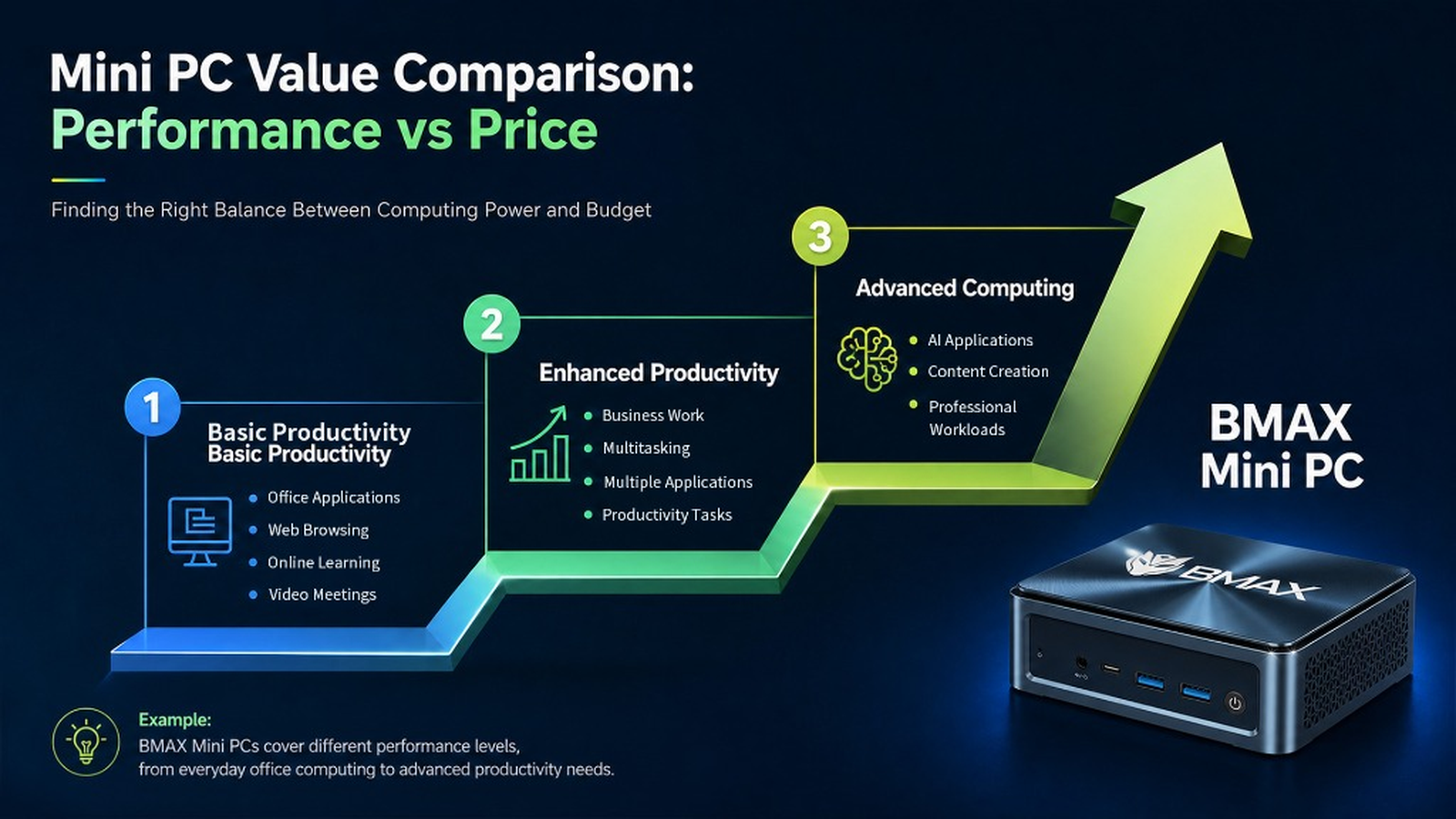
To systematically minimize both capital waste and workflow bottlenecks, modern enterprise mini PC architectures are categorized into three distinct operational tiers, each engineered for specific computational densities and budgetary parameters:
Basic Productivity Tier (Office, Web, Learning, POS): Configured for ultra-low power consumption (typically 10W-15W TDP) and quiet operation. Tailored for cloud applications, web browsing, multi-participant video conferencing, and continuous POS database connectivity without generating excess heat or acoustic noise.
Enhanced Productivity Tier (Multitasking & Business Fleets): Positioned as the core fleet workhorse. Powered by multi-core Core and Ryzen mobile architectures paired with 16GB system memory and NVMe high-speed storage, effortlessly handling simultaneous enterprise database queries, extensive spreadsheet manipulation, and dual-monitor workflows.
Advanced Computing & AI Tier (Heavy Workloads & Local Inference): Engineered for intensive commercial tasks, local AI agent workloads, and creative media editing. Incorporating next-generation Intel Core Ultra processors, integrated Neural Processing Units (NPUs), high-speed LPDDR5 memory, and Intel Arc graphics to deliver desktop-grade execution in a chassis weighing under 500 grams.
Comparative Architecture Analysis: Performance, Specifications, and Price Tiers
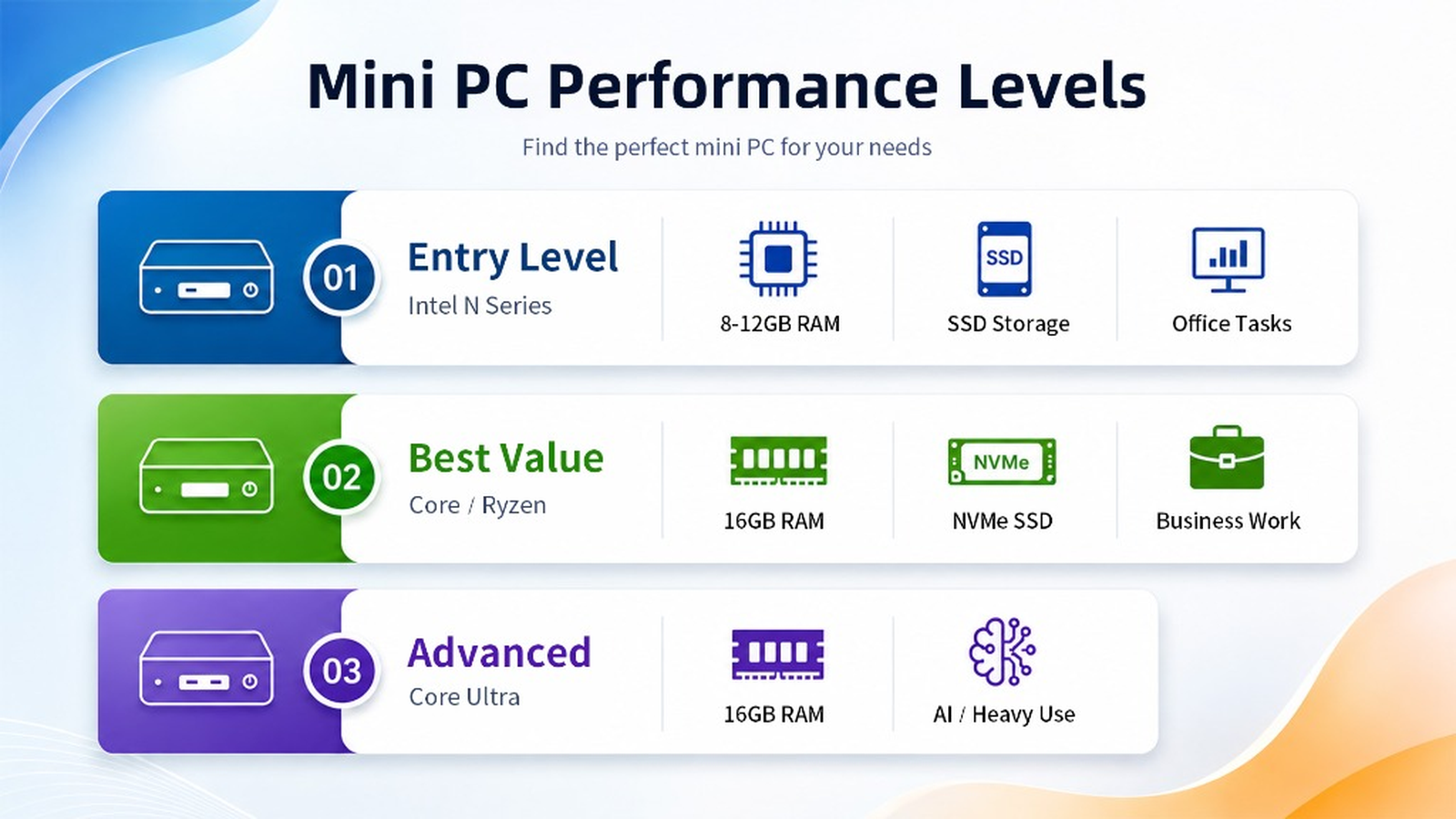
A granular analysis of processor architectures and hardware configurations reveals how different tiers achieve optimal price-to-performance efficiency across diverse commercial roles. By comparing distinct hardware tiers across the BMAX MaxMini portfolio against typical enterprise computing baselines, organizations can pinpoint the exact hardware configuration required for their operational scope:
Tier 1 - Ultra-Budget Dedicated Endpoints (BMAX B1 PLUS): Equipped with the Intel Celeron Processor J3355, 6GB of LPDDR3 memory at 1600MHz, and 128GB of internal solid-state storage. This ultra-compact platform delivers exceptional cost efficiency for dedicated single-purpose deployments such as hotel reception kiosks, warehouse inventory check-in, retail checkout registers, and student study desks, consuming a fraction of the electricity required by legacy desktop terminals.
Tier 2 - Home Office and Core Administrative Workstations (BMAX B6): Powered by the Intel Core i3-8109U processor, configured with 12GB of LPDDR memory at 1600MHz and a 256GB SATA SSD. This configuration represents an accessible entry point for remote administrative workers and students requiring reliable multi-tab browser performance, smooth document formatting, and dual-display capabilities without paying enterprise workstation premiums.
Tier 3 - Mainstream Corporate Fleets and Programming Sweet Spot (BMAX B6 Turbo): Featuring the powerful Intel Core i5-8257U processor, paired with 16GB of SO-DIMM DDR4 memory at 2400MHz and a rapid 512GB NVMe SSD. This tier establishes the definitive price-performance sweet spot for general office fleets, software developers, and financial analysts, delivering high IOPS responsiveness, rapid data compilation, and seamless multi-application switching.
Tier 4 - Advanced Professional Productivity (BMAX B11 Pro): Integrating the next-generation Intel Core Ultra 5 Processor 115U, 16GB of high-speed LPDDR5 memory clocked at 4400MHz, and a 512GB solid-state drive. Tailored for modern commercial environments utilizing on-device AI enhancements, advanced data visualization, and intensive multi-window multitasking across dual and triple display arrays.
Tier 5 -- Advanced AI Workstation and Heavy Compute (BMAX B12 Power): Driven by the Intel Core Ultra 9 Processor 185H, paired with 24GB of high-bandwidth LPDDR5 memory running at 4400MHz and a high-speed 1TB M.2 NVMe (PCIe 4.0 x4) 2280 SSD. Equipped with WiFi 6, Bluetooth 5.2, dedicated HDMI 2.1, DP 2.1, and Type-C triple-display interfaces, and the Space Capsule Cooling System, this compact workstation delivers efficient multi-threaded execution and on-device AI acceleration for technical leads and data-intensive commercial workflows.
Hardware Upgradability, Thermal Engineering, and Maintenance Economics
A critical dimension of compute value that retail comparisons often overlook is physical serviceability and hardware upgrade headroom. When evaluating mini PC architectures against proprietary pre-built towers or unserviceable all-in-one desktops, modular serviceability directly extends the functional lifespan of enterprise hardware deployments, lowering long-term depreciation costs.
Mainstream commercial models such as the BMAX B6 incorporate expandable memory options for general office tasks, whereas higher-tier commercial models such as the BMAX B12 Power utilize high-density soldered 24GB LPDDR5 memory operating at 4400MHz alongside a factory-installed 1TB M.2 PCIe 4.0 x4 2280 NVMe SSD, prioritizing maximum sustained bandwidth, power efficiency, and solid-state reliability.
Thermal engineering represents the foundation of sustained performance value. While budget PCs frequently suffer from thermal throttling under sustained multi-threaded loads, advanced thermal solutions--such as the specialized Space Capsule cooling architecture integrated into BMAX commercial units--utilize high-conductivity copper heat pipes and precision-balanced low-noise fans. This thermal management ensures that processors operate continuously at optimal turbo boost frequencies without acoustic disturbance or thermal degradation.
Total Cost of Ownership: Energy Efficiency, Regulatory Compliance, and Warranty Protection
Quantifying long-term hardware value requires analyzing total cost of ownership (TCO) across three critical pillars: ongoing power consumption, international regulatory compliance, and manufacturer warranty reliability. A fleet of 50 traditional 350W desktop towers running eight hours daily generates substantial annual utility expenses. Replacing these towers with ultra-efficient 15W to 45W commercial mini PCs achieves immediate 75% to 85% reductions in electrical overhead while drastically decreasing corporate carbon footprints and cooling loads.
For international distributors, cross-border retail partners, and corporate buyers, certified compliance is paramount to protecting operational continuity. Commercial hardware across all BMAX tiers holds comprehensive international certifications, including CE (EMC, LVD, RED), FCC (SDoC, ID), UKCA, PSE, RoHS, and UL safety standards. These certifications ensure frictionless customs clearance, fire safety compliance, and rigorous electromagnetic shielding across global enterprise deployments.
Furthermore, hardware reliability is reinforced through standardized factory warranty protocols and direct multi-regional technical support. Subjected to over 300 rigorous reliability test procedures--including high-temperature burn-in, vibration tolerance, and port duty-cycle stress tests--factory-direct engineering minimizes system downtime, protecting business productivity and ensuring high residual value throughout the deployment lifecycle.
Commercial Sourcing Decision Framework: Matching Hardware Tiers to Organizational Roles
To simplify hardware procurement and maximize departmental budget efficiency across multi-seat deployments, business owners and IT directors can utilize this practical selection framework:
Retail POS, Digital Signage & Kiosks (B1 PLUS / N-Series Tier): Targeted at budget-conscious retail checkout counters, hotel reception desks, and information kiosks requiring 24/7 continuous operation, ultra-low electricity draw, and compact footprint.
Mainstream Corporate Fleets & Administration (B6 / B6 Turbo Series): The optimal fleet solution for general office staff, customer service teams, and marketing coordinators requiring intensive multi-window multitasking, NVMe drive speed, and dual-display productivity.
Finance Directors, Engineering & Creative Leads (B11 Pro / B12 Power Series): High-performance workstations for heavy multi-sheet data analytics, local AI development, and triple 4K monitoring where processing throughput and LPDDR5 bandwidth are mission-critical.
Global Regulatory Compliance & Turnkey Support: All tiers carry comprehensive international certifications (CE, FCC, UKCA, PSE, RoHS), backed by standardized factory warranties and multi-regional technical support.
Conclusion and Commercial Sourcing Portal
Achieving maximum value in commercial computing hardware is not about acquiring the highest theoretical specifications, but rather establishing precise alignment between hardware capabilities, daily operational workflows, and budgetary constraints. By offering a transparent, five-tier hardware matrix spanning entry-level Celeron endpoints, versatile Core i3/i5 office fleet units, and Core Ultra 9 AI workstations, BMAX provides commercial buyers with quantifiable performance efficiency at every operational level.
To download detailed commercial specification sheets, review enterprise hardware configuration matrices, or access technical documentation, visit the official enterprise portal: https://bmaxbuy.com/. For enterprise consultations and evaluation trials, contact the commercial solutions department.
Media Contact
Hong Kong Creature Information Technology Co., Limited
18680233549
Room 617A, 6th Floor, Global Trade Plaza, 1 Sha Chau Road, Tsuen Wan, New Territories, Hong Kong
Source :Hong Kong Creature Information Technology Co., Limited
This article was originally published by IssueWire. Read the original article here.
More News










YOUR NEWS, OUR NETWORK.
Do you have Great News you want to tell the world?
Be it updates about your business or your community, you can make sure that it’s heard by submitting your story to our network reaching hundreds of news sites across 6 verticals.