
30th anniversary of “Le Petit Échotier”, the French magazine in Korea!

Jun 17, 2021

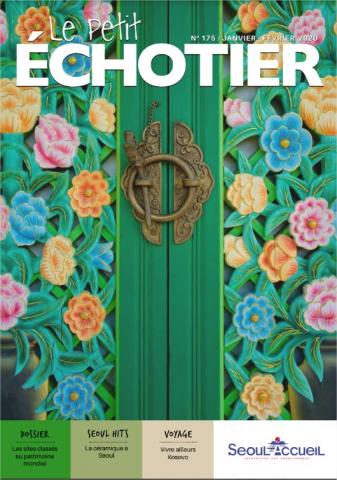
"Le Petit Échotier, le magazine français de Corée", the French magazine in Korea, is celebrating its 30th anniversary. It has evolved over the years to offer varied articles about life in Korea.
Seoul, Korea, Republic of - June 17, 2021 /PressCable/ —

30 years ago, nobody had heard of Korea, or knew much about that nation, except for the Korean War from 1950 to 1953. Thus, very few imagined ever moving to that country. The Hermit Kingdom, as it was once called, was on nobody’s radar.

However, little by little, as a French expat community, among others, started establishing itself in this -then- mysterious country, some newly-arrived individuals saw the need to better introduce its fascinating culture and beautiful landscapes. They also wanted to provide useful advice on everyday life to help their community. Last but not least, it was felt that a bridge needed to be built between the Korean people and the slowly growing French community. Thus, “Séoul Accueil“, a French non-profit organization, was formed to guide, and promote relationships among, the few isolated individuals and families having settled in this unfamiliar country. It was then that “le Petit Échotier, magazine français de Corée“, the French magazine in Korea, was founded to increase the reach of their actions.

At that time, writing about the country, its marvels and challenges was not an easy endeavor. There was no internet, no social media, and hardly any guidebook on that destination quite unknown to the outside world, and not yet an economic powerhouse and future home to K-pop and the famed movies and dramas that were to put South Korea on the map for the average person in the western world, and beyond, from the following decade.

Against all odds, “le Petit Échotier, magazine français de Corée” managed not only to survive but also thrive, thanks to the dedication of selfless volunteer team members, willing to share their discoveries and amazement. The language barrier did not hinder, too much, their pursuit of what makes this country so unique. Over the years, they have developed their magazine and now write about anything relevant to their audience: culture performances, social issues, Korean tourist spots, the history and customs of their host country, everyday life tips, literature, cinema… This superb publication is believed to be the only foreign language magazine in Korea.

When asked about the secret to their success, the Editor-in-chief replied, “it is essentially being curious about our country of adoption, knowing that we will never fully understand it, no matter how long we may be living here. Nonetheless, we try our best to share as many experiences as we can, not only toward the French community but also other expatriates who may have a passing knowledge of our language. We also do our best to make our editorial content interesting for Koreans attracted to French culture”.

Indeed, a great achievement, for which “le Petit Échotier, magazine français de Corée” is proud, is to have attracted Koreans to its readership, thus enabling a better understanding between both cultures. They now even have Korean editors within their team, writing in French!

The Petit Échotier’s main goal will be to have copies of their magazine distributed aboard flights between Korea and France within the next year. Therefore, they are looking for sponsoring partners that would make this financially sustainable and expand on the big companies already entrusting them with their advertising pages, such as Renault-Samsung, JCG Citroën, and Crédit Agricole Corporate & Investment Bank…

Contact Info:
Name: Rédacteur en chef
Email: Send Email
Organization: Le Petit Échotier
Address: Seoul, Korea, Republic of
Website: https://www.seoulaccueil.com/petit-echotier/

Source: PressCable

Release ID: 89028590

More News

Formula 1 announces return to Africa with Grand Prix in Rwanda in early 2030s
Oct 13, 2026

Formula 1 announces return to Africa with Grand Prix in Rwanda in early 2030s

KIGALI, Rwanda — Formula 1 will return to Africa with a grand prix in Rwanda starting early next decade once a new track has been built southeast of the capital, F1 and the country’s president said Tuesday. The announcement of a 10-year-deal to hold an African Grand Prix in Rwanda comes after a campaign by President Paul Kagame to bring F1 to the continent for the first time since 1993. “This partnership is long overdue,” Kagame said at a launch event in Kigali, Rwanda’s capital. “But it is a success and a milestone for the entire continent, especially for the African fans. Ultimately, what we want is for the African Grand Prix to pave the way for other races to be hosted on the continent.” Racing in Africa will fulfil a long-held ambition for seven-time world champion Lewis Hamilton, the only Black driver in F1. The 41-year-old British driver has said he has been “fighting in the background” for years to have a race in Africa. Exactly when the first race will be held in Rwanda remains unclear. F1 said a purpose-built circuit was expected to be completed “early in the next decade” in Bugesera, about 40 kilometers (25 miles) from Kigali. The track will be built near an under-construction airport serving the capital and will “work in harmony with the natural landscape,” using hills and dips in the landscape to challenge drivers, F1 said. “Today is a landmark moment for Formula 1," F1 President and chief executive Stefano Domenicali said. “With Rwanda joining the calendar from the next decade our sport will race in every inhabited continent, bringing the world championship closer than ever to fans around the globe.” The last time F1 raced in Africa was the South African Grand Prix in 1993. Rwanda aims for challenging circuit and economic gains Rwanda becomes the first confirmed new host nation for F1 since Qatar and Saudi Arabia joined the schedule in 2021. With a GDP per capita of just over $1,100, Rwanda will stand out on a race calendar that features glitzy destinations like Las Vegas, Miami, Monaco and Abu Dhabi. Kagame said the country aims to use the race to develop sports infrastructure and tourism and to diversify revenue. Under Kagame, Rwanda has sponsored major European soccer teams and developed a basketball partnership with the NBA, as well as hosting the world cycling championships. It’s all aimed at promoting a positive image of a country still often known internationally because of the 1994 genocide. Hosting F1 would take that strategy to a new level. “Look, our country will be watched on the global stage. And this comes with investments and creations of jobs, especially for the youth,” Betty Mukamurenzi, a university IT student in Kigali, told The Associated Press. Businessman James Ruzindana said that “for businesses, it is a challenge for us to up our game in terms of having the right products that can be consumed by those who are visiting.” The F1 spotlight could also bring renewed scrutiny of Rwanda's human rights record and accusations of “sportswashing.” Human rights groups have accused Kagame of repressive methods keep his grip on power. The U.N. has accused Rwanda of backing rebels in neighboring Congo, and Congolese officials have condemned its soccer sponsorships. Rwanda set to outpace South Africa There have been rival projects to bring F1 back to Africa, with plans in recent years regarding three different potential venues in South Africa and one in Morocco. South Africa Minister of Sports, Arts and Culture Gayton McKenzie issued a statement last week congratulating Rwanda, even before the decision was official, but still insisted his country “will get F1,” too. “We are happy for Rwanda’s 2030 F1. They have worked on it longer than SA and deserve it,” McKenzie wrote on X. “Remember though that one country, Italy, has had two F1s a year, and some react like a continent of 55 countries can only get one. SA will get F1, even before 2030.” There was no mention of South Africa in F1’s statement on Tuesday. F1 racing in Africa was linked to apartheid Many of F1’s previous races in Africa were overshadowed by the policy of apartheid in South Africa. F1 and its teams faced increasing criticism through the 1970s and 1980s, culminating in some teams boycotting the 1985 race in South Africa, which was facing various international sanctions and boycott campaigns at the time. As South Africa began to dismantle the system of racial segregation and oppression, F1 returned for two more races at the Kyalami circuit in 1992 and 1993, the last of those less than a year before the country’s first democratic elections where millions of Black South Africans were able to vote. F1 also held a Moroccan Grand Prix in 1958, the only time Morocco was part of the world championship. A project was announced last year to build a track to bring F1 back to the North African nation but there have been few updates since.

YOUR NEWS, OUR NETWORK.

Do you have Great News you want to tell the world?

Be it updates about your business or your community, you can make sure that it’s heard by submitting your story to our network reaching hundreds of news sites across 6 verticals.